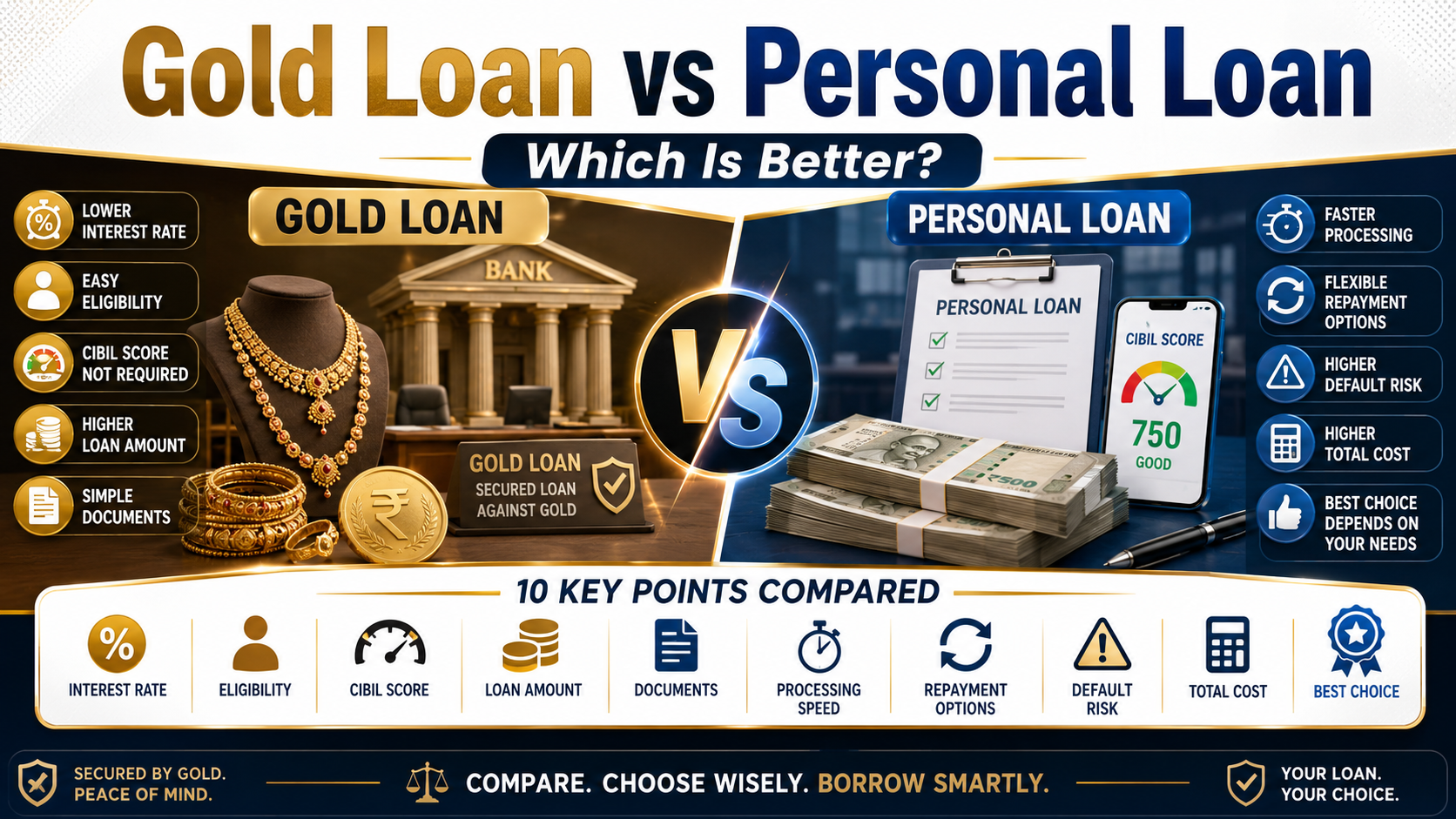

Gold Loan vs Personal Loan: 10 Key Differences
Gold Loan vs Personal Loan is an important comparison when you need money for an emergency, wedding, medical expense, education, travel or another personal requirement. Both loans can provide access to funds, but they work in very different ways.
A gold loan requires you to pledge eligible gold jewellery as security, while a personal loan is generally unsecured and usually does not require physical collateral. Because of this difference, their interest rates, eligibility rules, CIBIL impact, documentation, repayment options and default risks can also differ.
This complete guide from Loan Enquiry For You compares both options in simple language so you can decide which loan better matches your financial situation.

Table of Contents
1. Gold Loan Aur Personal Loan Me Basic Difference Kya Hai?
The biggest difference in the Gold Loan vs Personal Loan comparison is collateral. A gold loan is a secured loan. You pledge eligible gold jewellery, ornaments or permitted gold coins with the lender. The gold remains with the lender as security until the complete outstanding amount is repaid.
A personal loan is generally unsecured. In most cases, you do not need to pledge gold, property or another physical asset. This means the lender relies more on your income, credit profile and repayment capacity.
For example, SBI’s official Personal Loan information describes its salaried personal-loan product as not requiring security or a guarantor, while its Personal Gold Loan is backed by pledged gold ornaments. You can compare the official SBI Gold Loan and SBI Personal Loan pages for lender-specific examples.
This basic difference changes how both loans are assessed. In a gold loan, purity, net gold weight and collateral value are important. In a personal loan, salary, job stability, existing EMIs, CIBIL score and banking history can matter more.
The risk is also different. If a gold loan remains unpaid for a prolonged period, the pledged jewellery may eventually be auctioned after the applicable process. A personal loan has no pledged jewellery, but missed payments can still lead to collection action, charges and damage to your credit profile.
So the simplest way to remember the difference is: Gold Loan = secured by gold. Personal Loan = generally unsecured and based more heavily on income and creditworthiness.
2. Interest Rate: Gold Loan Ya Personal Loan Me Kaun Sasta Ho Sakta Hai?
Interest rate is one of the first things people compare in Gold Loan vs Personal Loan. Because a gold loan is backed by physical collateral, it can sometimes be priced lower than an unsecured personal loan.
However, you should not assume that every gold loan will always be cheaper than every personal loan. Actual rates vary by lender, product, borrower profile, repayment structure and prevailing market conditions.
Gold-loan pricing may differ between EMI, bullet-repayment and overdraft variants. Personal-loan rates can depend strongly on the applicant’s credit score, income, existing obligations and repayment history.
ICICI Bank’s official personal-loan information explains that loan pricing and approval can depend on the borrower’s profile and eligibility. You can review its current Personal Loan information for a lender example.
When comparing rates, look beyond the headline percentage. Calculate:
- Annual interest rate
- Processing fee
- Gold appraisal charges, if applicable
- Applicable taxes
- Prepayment charges
- Penal charges
- Total repayment amount
A gold loan may have a lower rate but also include appraisal-related costs. A personal loan may have a higher rate but no gold-valuation fee. Your final decision should therefore be based on total borrowing cost, not only the advertised rate.
If you want to understand gold-loan interest in more detail, read our Gold Loan Interest Rate Calculation guide.
3. Eligibility Kis Loan Me Easier Hoti Hai?
Eligibility can be very different when comparing Gold Loan vs Personal Loan.
A gold loan can sometimes have simpler eligibility because the lender receives valuable collateral. The applicant still needs to complete KYC, provide acceptable gold and satisfy the lender’s product requirements, but conventional income requirements can be lighter under some products.
A personal loan usually depends more heavily on the borrower’s financial profile because there is no physical collateral.
- Monthly salary or income
- Employer or profession
- Job stability
- Employment history
- Existing EMIs
- Credit score
- Repayment history
- Age and banking relationship
This means a borrower who owns sufficient eligible gold but has limited income documentation may sometimes find a gold loan more practical. Another borrower with a strong salary, stable employment and good credit history may find a personal loan easier because no jewellery needs to be pledged.
Neither loan is automatically approved. In a gold loan, the lender must still verify the purity, weight and ownership of the jewellery. In a personal loan, the lender must still be satisfied that the applicant can repay the unsecured debt.
A useful way to choose is to ask yourself two questions: Do I have enough eligible gold to pledge? and Is my income and credit profile strong enough for an unsecured loan?
For more information about how gold-loan approval works, see our Gold Loan Process guide.
4. CIBIL Score Ka Impact Gold Loan vs Personal Loan Me
CIBIL score is especially important in the Gold Loan vs Personal Loan comparison because personal loans are generally unsecured.
When there is no pledged asset, lenders rely more on your credit history to understand how you have handled previous debt. A strong credit profile can improve your chances of approval and may help you qualify for better terms.
A low score, recent missed payments or high existing debt can make personal-loan approval more difficult or expensive.
Gold loans are different because the lender has physical collateral. The value of the pledged gold therefore plays a much larger role in the loan decision.
However, borrowers should not assume that credit score never matters for gold loans. Banks and NBFCs can still follow internal credit policies, evaluate repayment capacity and report loan performance to credit bureaus.
Missing payments on either loan can damage your financial profile. With a personal loan, there is no pledged jewellery to auction, but credit-score damage can make future borrowing harder. With a gold loan, prolonged default can create both credit consequences and the risk of losing pledged jewellery.
So, if you have a strong credit profile but no gold, a personal loan may be more natural. If you have eligible gold but a weaker credit profile, a gold loan may sometimes provide a more practical secured option, subject to lender approval.
In both cases, repayment discipline matters. A secured loan should not be treated as risk-free simply because approval may be easier.
5. Loan Amount Kaise Decide Hota Hai?
The loan amount is calculated very differently in Gold Loan vs Personal Loan.
For a gold loan, the amount is closely linked to the eligible value of the pledged gold. The lender checks purity, net eligible weight, current valuation and applicable Loan-to-Value or LTV rules.
- Gold purity
- Net eligible weight
- Reference gold value
- Applicable LTV
- Lender’s product margin
Making charges, stones and design value do not automatically become additional collateral value. This is why the retail price written on a jewellery bill can be much higher than the gold-loan valuation.
For a personal loan, the amount is based more on your financial capacity and the lender’s unsecured credit model.
- Monthly income
- Existing EMIs
- Credit score
- Employer or profession
- Repayment history
- Requested loan amount
This creates a practical difference. Someone with valuable eligible gold but a modest salary may qualify for a meaningful gold loan. Someone without gold but with a high income and strong credit profile may qualify for a larger personal loan.
Do not automatically take the maximum offered amount. Borrowing more increases interest and repayment pressure. In a gold loan, it can also mean pledging more jewellery than necessary.
To understand how much jewellery may be required, read our Gold Loan Ke Liye Kitna Gold Chahiye guide.
6. Documents Aur Processing: Kaunsa Loan Faster Ho Sakta Hai?
Processing speed is another important part of Gold Loan vs Personal Loan.
Gold loans are often associated with relatively simple documentation because the loan is secured by jewellery. The lender still needs to complete KYC and verify the pledged gold, but some products may require fewer conventional income documents than an unsecured personal loan.
Gold appraisal is mandatory because the lender needs to check purity, net weight and eligible collateral value. This physical valuation step can take time, even if the paperwork itself is limited.
A personal loan does not require any jewellery appraisal. For eligible customers with an existing banking relationship or a pre-approved offer, the digital application process can sometimes be very fast.
Typical personal-loan documentation may include:
- PAN
- Aadhaar or other KYC documents
- Salary slips
- Bank statements
- Employment details
- Other income-related documents
So which one is faster? It depends on your situation. If you have eligible gold and complete KYC, a gold loan can be processed quickly after appraisal. If you already have a pre-approved personal loan, the unsecured option may be faster because no physical gold verification is needed.
Do not choose a loan only because it is instant. A fast loan with a high total cost or unsuitable repayment structure can create problems later.
7. Repayment Options Me Kya Difference Hai?
Repayment flexibility is one area where the Gold Loan vs Personal Loan comparison becomes especially useful.
Gold loans can offer multiple repayment structures, depending on the lender. These can include EMI-based repayment, bullet repayment and overdraft facilities.
An EMI gold loan spreads repayment across regular instalments. A bullet-repayment structure can require principal and interest according to the maturity terms. An overdraft can give flexible access to funds against an approved limit.
Personal loans are usually more straightforward. Most are repaid through scheduled monthly EMIs over an agreed tenure.
This difference matters because repayment structure affects your cash flow.
If you have stable monthly income, an EMI-based personal loan or EMI gold loan may be easier to budget. If you expect a large lump-sum payment after a few months, an appropriate bullet gold-loan product could fit better—but only if you are confident you can make the final payment.
Before accepting either loan, ask:
- How much must I pay every month?
- What amount will be due at maturity?
- Can I prepay the loan?
- Are there prepayment charges?
- What is the total repayment amount?
A repayment option that looks easy at the beginning can become difficult later if it does not match your income pattern. Choose the structure that fits how you actually earn and manage money.
8. Default Hone Par Risk Kis Loan Me Zyada Hai?
Default risk is one of the most important parts of the Gold Loan vs Personal Loan decision.
In a gold loan, your jewellery is pledged as security. If dues remain unpaid, the lender may eventually start an auction process after following applicable notice and recovery procedures.
This makes gold-loan default especially serious when the jewellery has emotional or family value.
A personal loan has no pledged jewellery, but default is still serious. Missed EMIs can result in late-payment charges, recovery action, negative credit reporting and difficulty getting future loans or credit cards.
The Reserve Bank of India publishes regulatory information relevant to lending and recovery practices. For current regulatory guidance, check the official RBI website.
So which loan carries more risk? It depends on what you are trying to protect.
- Gold Loan: direct risk to pledged jewellery plus possible credit impact.
- Personal Loan: no pledged jewellery, but significant credit and recovery consequences.
The best protection is to borrow less than your maximum eligibility and maintain enough cash flow to make payments on time.
Do not pledge valuable jewellery simply because gold-loan approval seems easier. Likewise, do not take a large personal loan only because you have a pre-approved offer.
9. Processing Fees Aur Total Cost Ko Kaise Compare Karein?
A lower interest rate does not always mean a cheaper loan. The Gold Loan vs Personal Loan comparison should always include the total cost of borrowing.
A gold loan may include:
- Interest
- Processing fee
- Gold appraisal charges
- Applicable taxes
- Penal charges
- Other product-specific fees
A personal loan may include processing fees, applicable taxes, pre-closure charges and other costs depending on the lender and product.
Imagine a gold loan with a lower annual rate but additional appraisal and processing costs, while a personal loan has a slightly higher rate but fewer upfront charges. You cannot know which is cheaper until you calculate the actual rupee amount you will pay.
Compare the following:
- Loan amount
- Total interest
- Processing fee
- Appraisal fee
- Applicable taxes
- Prepayment or foreclosure charges
- Other compulsory fees
Also compare the repayment period. A lower rate over a much longer tenure can sometimes result in more total interest than a slightly higher rate repaid quickly.
Ask for the lender’s Key Fact Statement or equivalent cost disclosure before signing. The better loan is the one that gives you a reasonable total cost and a repayment structure you can comfortably manage.
10. Gold Loan vs Personal Loan: Aapke Liye Kaunsa Better Hai?
After comparing all the major factors, there is no universal winner in Gold Loan vs Personal Loan.
A gold loan may be better when:
- You own sufficient eligible gold.
- You are comfortable pledging jewellery.
- You need funds for a relatively short period.
- Your personal-loan credit profile is not strong.
- The secured-loan total cost is lower.
- You have a clear repayment plan.
A personal loan may be better when:
- You do not own enough eligible gold.
- You do not want to pledge family jewellery.
- You have stable income.
- Your credit profile is strong.
- You want a longer EMI-based repayment tenure.
- You qualify for a competitive unsecured offer.
Sometimes neither option is appropriate. If the expense is not urgent and repayment would put your monthly budget under pressure, waiting and saving may be safer.
Before deciding, compare both offers on the same basis: same approximate loan amount, similar repayment period, total interest, fees, monthly payment, prepayment conditions and risk if your income falls.
Do not choose a gold loan only because approval seems easier, and do not choose a personal loan only because no collateral is required. The better option is the one you can repay comfortably at the lowest reasonable total cost while accepting the risks involved.
Gold Loan vs Personal Loan: Quick Comparison Table
| Feature | Gold Loan | Personal Loan |
|---|---|---|
| Collateral | Gold required | Usually not required |
| Credit score importance | Can be lower depending on lender | Usually more important |
| Loan amount basis | Gold value and LTV | Income and credit profile |
| Processing | KYC + gold appraisal | KYC + income/credit checks |
| Repayment | EMI, bullet or overdraft may be available | Usually EMI-based |
| Main default risk | Pledged gold may be auctioned | Credit damage and recovery action |
Frequently Asked Questions
Gold Loan vs Personal Loan: Which Has Lower Interest?
A gold loan can sometimes have a lower rate because it is secured by gold, but this is not guaranteed. Compare the actual rate and total fees offered to you by regulated lenders.
Which Loan Is Better for a Low CIBIL Score?
A gold loan may sometimes be more practical because it is backed by collateral, but lenders can still assess repayment capacity and credit history. Approval is never guaranteed.
Is a Personal Loan Safer Than a Gold Loan?
A personal loan does not put jewellery at direct risk because no gold is pledged. However, default can still damage your credit profile and lead to recovery action. Both loans carry serious repayment responsibilities.
Can I Get a Bigger Loan with Gold or with Salary?
It depends on your profile. Gold-loan eligibility depends mainly on eligible gold value and LTV, while personal-loan eligibility depends more on income, existing debt and credit profile.
Which Loan Is Better for a Short-Term Emergency?
A gold loan can be useful when you own eligible jewellery and need short-term funds, while a pre-approved personal loan can also be fast. Compare total cost and repayment risk before deciding.
Conclusion: Gold Loan vs Personal Loan – Which Should You Choose?
Gold Loan vs Personal Loan does not have one universal winner. Gold loans can be useful when you have eligible jewellery, need funds quickly and are comfortable pledging an asset. Personal loans can be convenient when you have strong income and credit history and do not want to pledge jewellery.
Compare the complete loan rather than only the advertised interest rate. Check eligibility, total interest, processing fees, repayment tenure, CIBIL impact and default risk.
If you choose a gold loan, remember that your jewellery remains at risk until the loan is closed. If you choose a personal loan, remember that missed payments can seriously affect your credit profile.
For more useful guides, read our Gold Loan Kaise Le, Gold Loan Process, Gold Loan Interest Rate Calculation and Gold Loan Gold Requirement articles.
Disclaimer
This article is for general informational and educational purposes only and should not be treated as financial advice. Interest rates, eligibility rules, processing fees, repayment terms and lender policies can change. Always verify the latest information directly with the relevant regulated bank, NBFC or lender before applying for a loan.



Pingback: Gold Loan Na Chukane Par Kya Hota Hai? 5 Serious Risks