
Primary Focus Keyword: Gold Loan Ke Liye Kitna Gold Chahiye
Secondary Keywords: Gold Loan Gold Requirement | Gold Loan Per Gram | Gold Loan Gold Weight | Gold Loan LTV
SEO Title: Gold Loan Ke Liye Kitna Gold Chahiye? 10 Important Facts
Slug: gold-loan-ke-liye-kitna-gold-chahiye
Meta Description: Gold Loan Ke Liye Kitna Gold Chahiye? Learn minimum gold requirement, purity, weight, LTV, per-gram valuation, gold coins and practical loan examples.
Gold Loan Ke Liye Kitna Gold Chahiye? 10 Important Facts
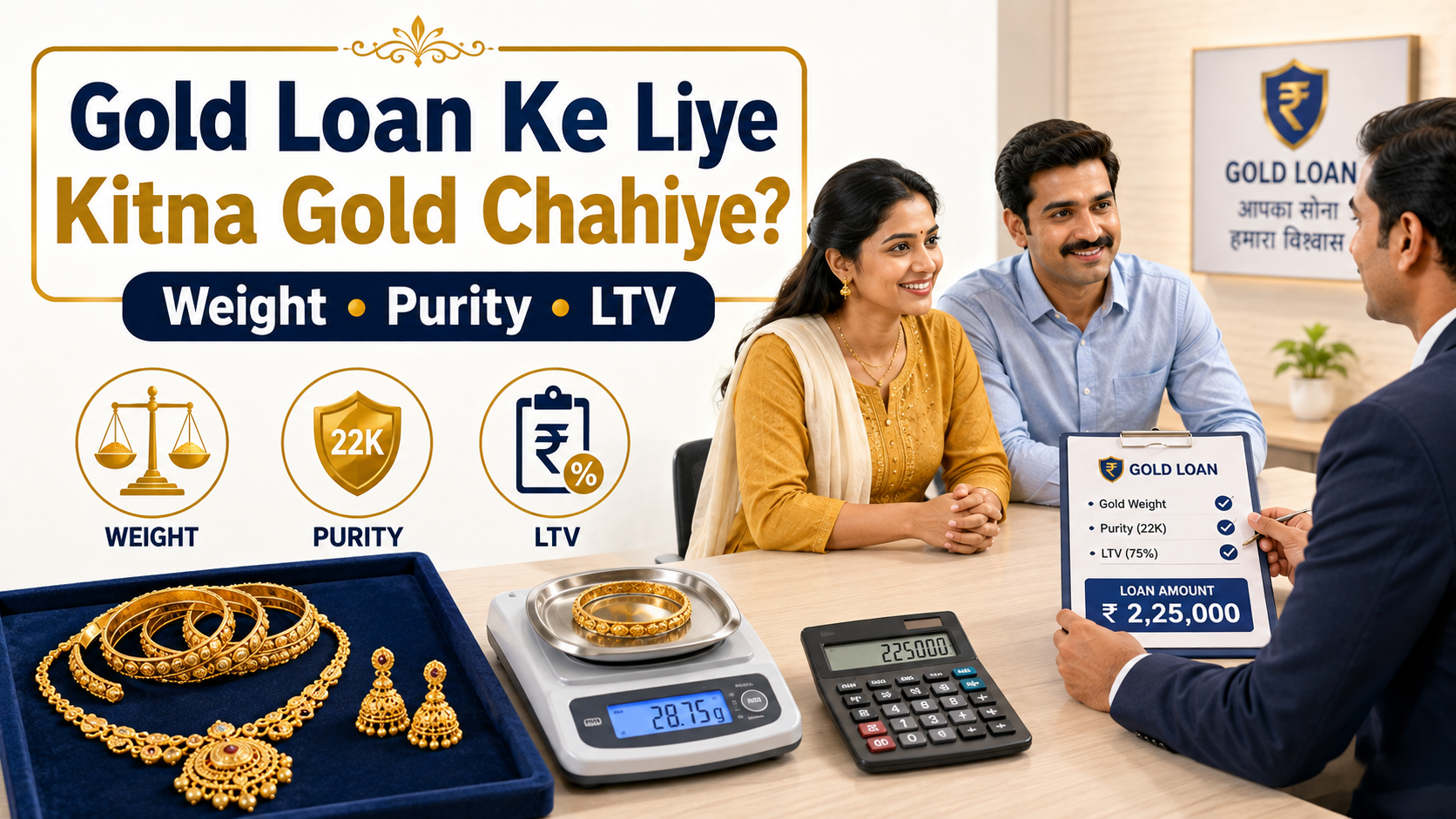
Gold Loan Ke Liye Kitna Gold Chahiye? Iska exact answer sirf grams dekhkar nahi diya ja sakta. Required gold quantity depends on your loan amount, gold purity, net eligible weight, lender valuation and the applicable Loan-to-Value or LTV ratio.
For example, two people may both bring 20 grams of jewellery, but one may receive a higher eligible loan amount because the gold is purer or contains fewer stones and non-gold materials. This complete guide from Loan Enquiry For You explains how lenders estimate the gold required for different loan amounts.

Table of Contents
1. Gold Loan Ke Liye Minimum Kitna Gold Chahiye?
The first thing to understand is that there is no universal rule saying every borrower must pledge a fixed number of grams. The minimum gold required depends mainly on the lender’s minimum loan amount and the eligible value assigned to your jewellery.
This is why the question Gold Loan Ke Liye Kitna Gold Chahiye cannot be answered with one permanent number like 10 grams or 20 grams.
For example, SBI currently lists a minimum Personal Gold Loan amount on its official product page. But the bank does not simply say that every applicant must bring the same fixed number of grams. The actual quantity needed depends on purity, net weight, valuation and product margin.
Suppose two borrowers each bring 10 grams of jewellery. One ornament may be higher purity and almost entirely gold, while the other may contain stones, strings or other non-gold materials. Even though the gross weight is the same, their eligible values can be different.
A better way to think about the requirement is to first decide how much loan you actually need. Then the lender can estimate how much eligible gold value is required under the applicable LTV and its own product policy.
Before visiting a branch, check the lender’s minimum loan amount and latest eligibility conditions. This will give you a more realistic idea of how much jewellery you may need to carry for appraisal.
2. Gold Ka Weight Loan Amount Ko Kaise Affect Karta Hai?
Gold weight is one of the biggest factors affecting how much loan may be available. If purity and valuation remain similar, a higher eligible gold weight can usually support a higher collateral value.
But when calculating Gold Loan Ke Liye Kitna Gold Chahiye, you should focus on eligible net gold weight rather than only the gross jewellery weight.
Imagine a necklace that weighs 30 grams in total. If it contains stones, beads, strings or other non-gold materials, the lender can deduct those parts. If the eligible net gold weight becomes 25 grams, the loan calculation is based mainly on those 25 grams and the assessed purity.
Gold purity also changes the value of the same physical weight. Twenty grams of higher-purity jewellery may have a higher eligible value than 20 grams of lower-purity gold.
ICICI Bank’s official Gold Loan Calculator asks for gold weight and carat, showing why both quantity and purity matter when estimating eligibility.
Eligible Gold Value ≈ Net Gold Weight × Eligible Per-Gram Value
The lender then applies the applicable LTV or margin to determine the possible loan amount. Final eligibility is decided only after physical verification and lender appraisal.
3. 22K, 20K Aur 18K Gold Se Kitna Loan Mil Sakta Hai?
Gold purity has a major impact on valuation. If two jewellery items weigh the same but have different purity, the higher-purity item generally contains more actual gold and can therefore have a higher eligible value.
This is another reason why Gold Loan Ke Liye Kitna Gold Chahiye depends on more than grams alone.
For example, 20 grams of 22K jewellery and 20 grams of 18K jewellery are not equivalent in intrinsic gold content. The lender assesses the actual purity and values the collateral accordingly.
A lower-purity ornament may require more grams to support the same loan amount, assuming all other factors remain equal.
Current lender calculators commonly ask borrowers to select the carat of the gold rather than treating every gram as identical. ICICI Bank’s calculator, for example, uses purity and weight together to generate an indicative estimate.
Do not assume that the hallmark printed on the jewellery is the final loan valuation. The lender or authorised appraiser performs its own purity test before sanctioning the loan.
- Higher purity can increase eligible per-gram value.
- Lower purity can reduce eligible value for the same weight.
- Stones and non-gold components can reduce net weight further.
- Final valuation depends on the lender’s appraisal.
Always ask the lender what purity was recorded during the appraisal and how that figure affected the final collateral value.
4. Gross Weight Aur Net Gold Weight Me Kya Difference Hai?
Gross weight means the total weight of the jewellery as presented. Net gold weight is the actual eligible gold weight after deducting non-gold materials.
This difference is extremely important when estimating Gold Loan Ke Liye Kitna Gold Chahiye.
Suppose a necklace weighs 40 grams. You may initially think the lender will value all 40 grams as gold. But if 6 grams are attributable to stones, threads, wax, hooks or other materials, the eligible weight can be much lower, subject to actual appraisal.
That is why weighing jewellery at home does not give you the final loan eligibility.
The lender is primarily interested in the intrinsic gold content. Making charges, retail design value and decorative materials do not become extra gold collateral simply because they increased the jewellery’s purchase price.
- Gross jewellery weight
- Weight deducted for non-gold components
- Net eligible gold weight
- Purity or carat recorded
- Final eligible collateral value
Knowing these numbers helps you understand why the lender’s loan estimate may be lower than what you expected based on the jewellery bill or household weighing scale.
5. Gold Loan Me LTV Kitna Important Hai?
LTV stands for Loan-to-Value ratio. It represents the maximum percentage of eligible collateral value that may be provided as a loan under the applicable framework and lender policy.
LTV is one of the most important parts of answering Gold Loan Ke Liye Kitna Gold Chahiye because lenders do not normally provide 100% of the eligible gold value as a loan.
| Total Consumption Loan Amount | Maximum LTV |
|---|---|
| Up to ₹2.5 lakh | 85% |
| Above ₹2.5 lakh and up to ₹5 lakh | 80% |
| Above ₹5 lakh | 75% |
These tiers form part of the current RBI framework for applicable consumption loans against eligible gold and silver collateral. For current regulatory updates, check the official Reserve Bank of India website.
Suppose your eligible gold value is ₹1,00,000 and an 85% maximum LTV applies. The theoretical maximum loan would be ₹85,000. The lender can still sanction less depending on its product margin and internal policy.
Therefore, if a lender uses a lower effective LTV or higher margin, you may need more eligible gold value for the same required loan amount.
6. ₹50,000, ₹1 Lakh Ya ₹2 Lakh Loan Ke Liye Approx Kitna Gold Chahiye?
A permanent answer such as “₹1 lakh ke liye exactly 10 grams chahiye” is not reliable because gold prices, purity and lender valuation change over time.
The better method for estimating Gold Loan Ke Liye Kitna Gold Chahiye is to work backwards from the loan amount.
Required Eligible Gold Value = Required Loan Amount ÷ Applicable LTV
Approximate Gold Grams = Required Eligible Gold Value ÷ Eligible Per-Gram Gold Value
For example, if you need ₹1 lakh and an 85% LTV applies, ₹1,00,000 ÷ 0.85 ≈ ₹1,17,647 eligible collateral value.
You would then divide ₹1,17,647 by the lender’s eligible per-gram value for your actual gold purity. Because that per-gram value changes, a responsible article should not permanently hard-code a gram figure.
The same approach can be used for ₹50,000 or ₹2 lakh. Final eligibility still depends on physical gold verification, net weight, purity and lender policy.
7. Stones Aur Making Charges Count Hote Hain Ya Nahi?
A jewellery purchase bill can include much more than the raw gold value. You may have paid for making charges, design work, stones, gems and taxes.
But when estimating Gold Loan Ke Liye Kitna Gold Chahiye, the complete retail purchase price should not be treated as the collateral value.
The lender mainly focuses on the intrinsic value of the eligible gold. Stones and other non-gold components can be deducted from weight, while making charges do not become additional collateral value.
For example, imagine a designer necklace was purchased for ₹2.5 lakh. A significant part of the price may have come from craftsmanship and expensive stones. The lender may still value the gold component at a much lower figure.
- Making charges do not increase intrinsic gold weight.
- Stones can reduce net eligible weight.
- Design cost does not automatically increase loan value.
- Purity and net gold content matter more than retail price.
If your jewellery contains a large number of stones, be prepared for the eligible weight to be lower than the gross weight. Ask the appraiser to explain all deductions before accepting the loan offer.
8. Gold Coins Se Loan Mil Sakta Hai? Kitne Gram Tak?
Certain gold coins may be eligible for gold loans, but every coin should not be assumed to qualify. Acceptance depends on applicable regulations and the lender’s product policy.
This also matters when calculating Gold Loan Ke Liye Kitna Gold Chahiye because coins and jewellery can be subject to different conditions.
SBI’s official Personal Gold Loan information mentions gold ornaments and specially minted gold coins sold by banks under its product conditions. Check the latest details on the official SBI Personal Gold Loan page.
Before visiting the branch, ask whether the particular coin is accepted, whether its source matters, what weight limit applies and whether coins and jewellery can be pledged together.
Even an accepted coin does not guarantee a fixed loan amount. Purity, current valuation and applicable LTV still determine the actual offer.
9. Gold Ki Purity Aur Valuation Branch Me Kaise Check Hoti Hai?
When you apply for a gold loan, the lender needs to determine the actual eligible value of the jewellery you are pledging.
This appraisal is the final practical step in answering Gold Loan Ke Liye Kitna Gold Chahiye.
The authorised appraiser checks the jewellery’s purity and weight. The lender then calculates eligible net gold content after deducting non-gold components.
The appraiser may record whether the jewellery is 22K, 20K, 18K or another accepted purity. Lower-purity jewellery contains less pure gold in the same physical weight, so its eligible value can be lower.
ICICI Bank’s calculator asks for both carat and weight and states that final eligibility is decided after physical gold verification. This is a useful reminder that online tools provide estimates, not guaranteed sanctions.
- Check the purity recorded.
- Check gross weight.
- Check net eligible weight.
- Ask about deductions.
- Check final assessed gold value.
Once the eligible value is known, the lender applies the relevant LTV or product margin and tells you the actual loan amount available.
10. Loan Lene Se Pehle Kitna Gold Pledge Karna Chahiye?
Owning a large amount of jewellery does not mean you should pledge all of it.
The safest answer to Gold Loan Ke Liye Kitna Gold Chahiye is usually: only enough eligible gold to support the loan amount you genuinely need.
Suppose your jewellery could support a ₹3 lakh loan but your actual emergency expense is only ₹1 lakh. Taking the maximum possible loan can increase interest cost, repayment pressure and the amount of jewellery kept as collateral.
Instead, tell the lender the amount you really need and ask how much eligible gold would be sufficient for that amount under the applicable valuation and LTV.
This approach can be particularly useful when jewellery has emotional or family value.
- Decide your real funding requirement first.
- Ask how much eligible gold is needed.
- Do not borrow extra simply because it is available.
- Check the repayment method and tenure.
- Keep valuable jewellery outside the pledge if it is not required.
Borrowing only what you need can reduce interest cost and repayment stress.
Gold Loan Ke Liye Kitna Gold Chahiye: Quick Checklist
- Decide the exact loan amount you need.
- Check your jewellery purity.
- Estimate the net eligible gold weight.
- Check the lender’s per-gram valuation.
- Confirm the applicable LTV or margin.
- Exclude making charges and stones.
- Check whether coins are accepted.
- Compare more than one regulated lender.
- Confirm the final branch valuation.
- Pledge only the amount of gold you actually need.
Frequently Asked Questions
Gold Loan Ke Liye Kitna Gold Chahiye for ₹1 Lakh Loan?
There is no fixed permanent gram figure. First divide the required loan amount by the applicable LTV to estimate the eligible collateral value required. Then divide that value by the lender’s eligible per-gram valuation for your gold purity.
Can 10 Grams of Gold Be Enough for a Gold Loan?
It can be enough for some loan amounts, but the answer depends on purity, net weight, current valuation, LTV and the lender’s minimum loan amount. The branch appraisal gives the final answer.
Does 18K Gold Get a Lower Loan Than 22K Gold?
For the same eligible weight, lower-purity gold generally has a lower intrinsic gold value than higher-purity gold. Therefore, more grams may be required to support the same loan amount, assuming other conditions are equal.
Do Stones Increase Gold Loan Value?
No. Stones and other non-gold materials generally do not increase the intrinsic gold value used for loan eligibility. Their weight can instead be deducted when calculating net eligible gold content.
Can I Pledge Only Part of My Jewellery?
Depending on the lender’s process, you may be able to pledge only enough eligible jewellery to support the amount you need. Ask the lender before submitting all your ornaments for appraisal.
Conclusion: Gold Loan Ke Liye Kitna Gold Chahiye?
Gold Loan Ke Liye Kitna Gold Chahiye? The correct answer depends on your required loan amount, gold purity, net eligible weight, current valuation and applicable LTV. There is no single fixed gram requirement that works for everyone.
Instead of asking only how many grams are required, first calculate how much money you actually need. Then compare that amount with the eligible value of your gold and the lender’s applicable LTV.
You can also read our Gold Loan Kaise Le guide, Gold Loan Process guide and Gold Loan Interest Rate Calculation guide for more information.
Always verify the final purity, net weight and valuation at the branch before accepting the loan. Borrow only the amount you genuinely need and avoid pledging more jewellery than necessary.
Disclaimer
This article is for general informational and educational purposes only. It should not be considered financial advice or a guarantee of any specific loan amount. Gold prices, LTV limits, valuation methods, lender policies and eligibility requirements can change. Always verify the latest details directly with the relevant regulated bank, NBFC or lender before applying for a gold loan.

Pingback: Gold Loan vs Personal Loan: 10 Key Differences
Pingback: Gold Loan Eligibility: 8 Important Criteria and Documents