
Gold Loan Eligibility: 8 Important Criteria and Documents
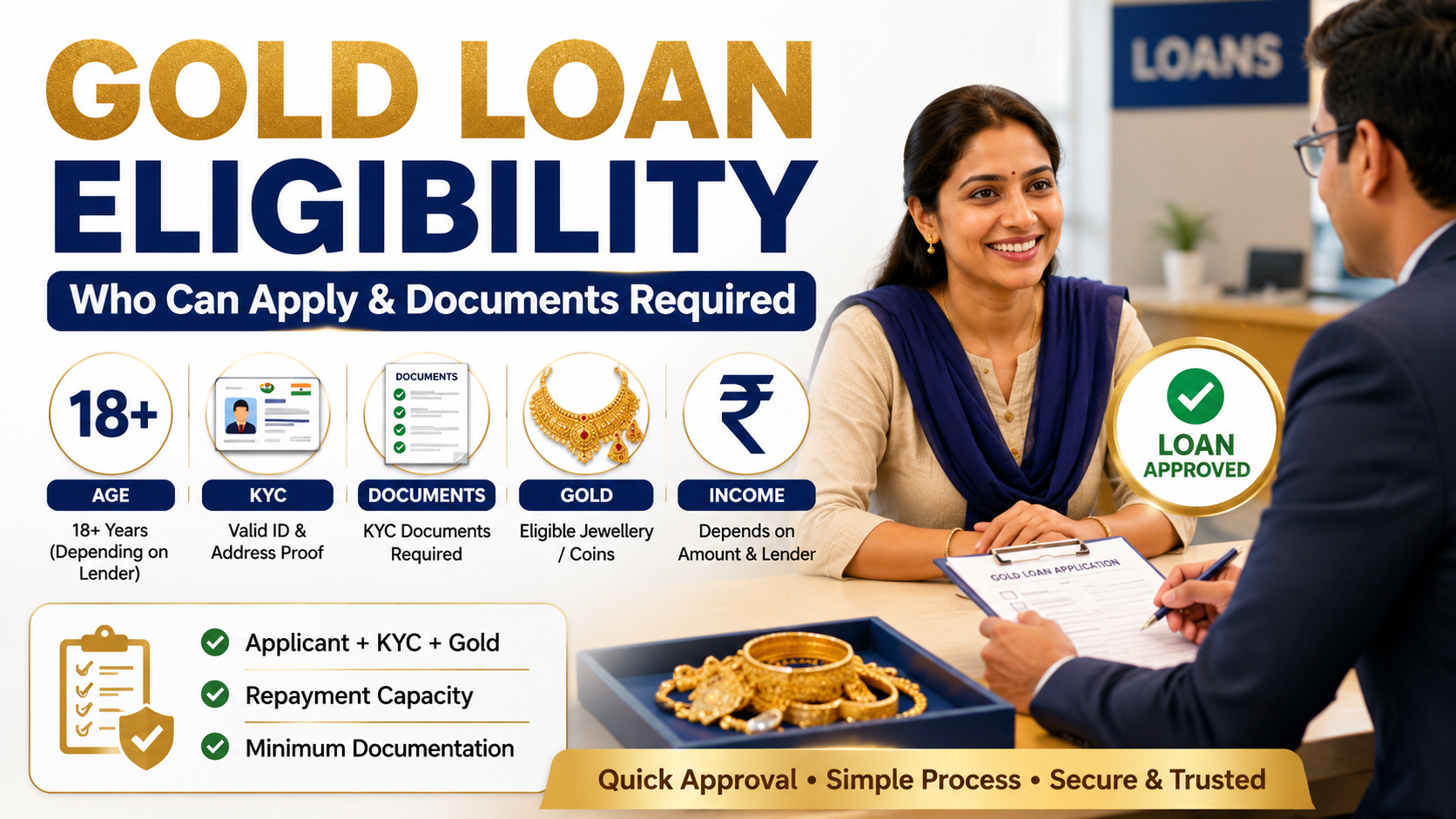
Gold Loan Eligibility depends on more than simply owning gold jewellery. A lender may check your age, KYC status, repayment capacity, gold ownership, purity, net weight and requested loan amount before approving the application.
Because a gold loan is secured by pledged gold, the eligibility process can be simpler than some unsecured loans. However, complete documents alone do not guarantee approval. This guide from Loan Enquiry For You explains who can apply, which KYC documents may be required and what lenders normally check before sanctioning a gold loan.

Table of Contents
1. Gold Loan Ke Liye Kaun Apply Kar Sakta Hai?
Gold Loan Eligibility lender ke product rules par depend karti hai, lekin generally adult individuals who can provide eligible gold and complete KYC may be able to apply.
For example, SBI’s current Personal Gold Loan eligibility says applicants must be 18 years or older and should have a steady source of income. SBI also lists pensioners and bank employees among eligible applicant categories. For loan amounts above ₹2.5 lakh, SBI currently asks for supporting income documents. You can verify current lender-specific requirements on the official SBI Personal Gold Loan page.
This means salaried employment is not the only route to a gold loan. Depending on the lender, applicants may include salaried employees, self-employed individuals, business owners, pensioners and other individuals with acceptable repayment capacity.
The lender wants to know whether you are a genuine customer, whether the pledged gold is acceptable and whether the loan can realistically be repaid.
Some borrowers assume that because jewellery is being pledged, the lender will approve any application immediately. That is not necessarily true. The lender still performs customer due diligence, evaluates the collateral and may ask questions about ownership.
Before applying, confirm three things: Am I old enough to apply? Can I complete KYC? Do I have acceptable gold and a realistic repayment source?
If all three answers are yes, the next step is to check the lender’s exact documentation and loan amount requirements.
2. Age Requirement Kya Hoti Hai?
Age is one of the first conditions checked under Gold Loan Eligibility. There is no single universal age rule that should automatically be applied to every bank and NBFC.
SBI currently states that applicants for its Personal Gold Loan must be 18 years and above. This is a lender-specific example, not a universal rule for every gold-loan product.
Some lenders may also have maximum-age conditions or special repayment requirements for older borrowers. This can matter for pensioners, senior citizens, applicants choosing longer EMI tenures or joint applicants.
Age verification is normally completed through KYC documents. Passport, driving licence, proof of possession of Aadhaar or voter ID may contain identity and date-of-birth information, depending on the lender’s process and applicable KYC rules.
Borrowers should ensure that the date of birth shown in their KYC records is correct. If Aadhaar, PAN, bank records and another identity document show conflicting details, the lender may ask for clarification or updated documents.
- Check name spelling across all documents.
- Check date of birth.
- Check current address.
- Check PAN details.
- Check mobile number linked with your banking profile.
Age may look like a small requirement, but inconsistent identity information can delay the application process. For smoother Gold Loan Eligibility, update incorrect KYC information before applying where possible.
3. Income Proof Zaroori Hai Ya Nahi?
Income proof is one of the most common questions related to Gold Loan Eligibility. Because gold is pledged as collateral, income-document requirements can sometimes be simpler than an unsecured personal loan.
However, this does not mean income and repayment capacity are always irrelevant. SBI’s current Personal Gold Loan information says that conventional income proof may not be required in many cases, while supporting income documents are currently required for loan amounts above ₹2.5 lakh.
This is a useful example of why borrowers should read the complete lender conditions instead of relying only on a line such as “income proof not required.”
Depending on the borrower and loan amount, supporting documents may include salary slips, bank statements, pension records, business-income information or other lender-requested financial documents.
Gold collateral and repayment capacity answer two different questions. Gold tells the lender how much security is available. Repayment capacity tells the lender whether the borrower can actually repay according to the chosen EMI, bullet or overdraft structure.
Suppose your gold supports a large loan amount but your monthly cash flow is weak. Taking the maximum available amount may still be risky.
Before applying, ask: Will income proof be required for my requested amount, and which documents are acceptable?
If you want to understand repayment structures before deciding the loan amount, read our Gold Loan Repayment Options guide.
4. Kaunsa Gold Eligible Hota Hai?
Gold Loan Eligibility borrower ke saath-saath pledged gold par bhi depend karti hai. Not every form of gold is automatically accepted.
Banks and NBFCs generally accept eligible gold jewellery or ornaments subject to applicable rules and product policies. SBI’s current Personal Gold Loan information includes gold ornaments and certain specially minted gold coins sold by banks under its product terms.
The lender may check purity, gross weight, net eligible gold weight, ownership, type of ornament and the presence of stones or other materials.
Purity matters because lower-purity jewellery contains less actual gold per gram. Non-gold components also matter. If a necklace contains stones, strings, wax or decorative material, the complete gross weight may not be treated as eligible gold weight.
- Gold purity
- Gross weight
- Net eligible gold weight
- Stones and other deductions
- Ownership
- Type of collateral
Do not attempt to pledge jewellery whose ownership is unclear or disputed. The lender may ask questions or require declarations regarding ownership.
Before visiting a branch, ask the lender whether your jewellery or coins are accepted and how stones will be deducted.
For more information about quantity and valuation, read our Gold Loan Ke Liye Kitna Gold Chahiye guide.
5. Gold Loan Ke Liye KYC Documents Kaunse Chahiye?
KYC is one of the most important parts of Gold Loan Eligibility. KYC means Know Your Customer, and the lender needs to verify your identity and address before processing the lending relationship.
SBI’s current Personal Gold Loan checklist separates existing fully KYC-compliant customers from customers whose KYC needs updating and from new-to-bank customers.
Typical documents may include:
- Gold-loan application form
- Recent passport-size photographs
- Identity proof
- Address proof
- PAN or Form 60 where applicable
- Other lender-requested information
RBI’s KYC framework requires regulated entities to follow customer-identification and due-diligence requirements. For the latest official regulatory information, check the Reserve Bank of India website.
If your address has recently changed, inform the lender. If your name differs across documents, resolve the mismatch before applying where possible.
Never submit altered or fake documents to speed up approval. Incorrect KYC can delay the application and create bigger problems later.
Before going to the branch, check the lender’s latest official document checklist and carry originals if physical verification may be required.
Complete and accurate KYC makes the Gold Loan Eligibility process smoother because the lender can focus on gold appraisal instead of resolving identity problems.
6. Aadhaar, Voter ID, Driving Licence Ya Passport Ka Role
Aadhaar, voter ID, driving licence and passport are commonly used in banking because they may serve as Officially Valid Documents under RBI’s KYC framework, subject to applicable conditions.
RBI’s KYC framework recognises several OVDs, including passport, driving licence, proof of possession of Aadhaar number, voter identity card, NREGA job card signed by an authorised state government officer and certain National Population Register documents.
This does not mean you need to submit every one of these documents. The lender needs acceptable KYC documentation according to its process and regulatory requirements.
Additional documentation may be required if your address is outdated, your name differs across records, PAN details are missing or the lender requires additional customer verification.
When preparing for Gold Loan Eligibility, make sure personal details are readable and current. If a document contains an old address, ask the lender what alternative proof can be accepted.
Do not assume a screenshot or unofficial copy will always be sufficient. Depending on the process, the lender may require original verification, certified copies or permitted electronic KYC methods.
The safest approach is to check the lender’s official KYC requirements before applying. Good KYC preparation can make the application much faster.
7. Existing Customer Aur New Customer Me Kya Difference Ho Sakta Hai?
Existing customer status can sometimes simplify Gold Loan Eligibility because the bank may already have verified KYC information.
SBI’s current document checklist separately identifies fully KYC-compliant existing customers and new or non-KYC-compliant customers. A fully KYC-compliant existing customer can have a simpler document requirement under that product.
A new customer is not automatically ineligible. The lender may simply need to complete customer onboarding and KYC before disbursement.
An existing bank customer may already have:
- Verified identity details
- Address information
- PAN
- Registered mobile number
- Existing account relationship
- Banking history
However, do not assume an old account means your KYC is fully updated. If periodic KYC is due or your address has changed, the bank may still ask for updated information.
Before applying, an existing customer should ask, “Is my account fully KYC compliant?”
A new customer should ask, “Do I need to open an account or complete any additional onboarding before loan disbursement?”
Knowing this before visiting the branch can reduce unnecessary paperwork and delays.
8. Final Approval Sirf Documents Se Nahi Hota
Complete documents are important, but Gold Loan Eligibility does not mean automatic loan approval. After KYC is complete, the lender still evaluates the pledged gold and the loan request.
The lender may check gold purity, gross weight, net eligible weight, stones and other deductions, eligible collateral value, ownership, requested loan amount and repayment capacity.
The final loan amount also depends on valuation. A borrower may believe jewellery is worth ₹3 lakh because that was its retail purchase price, but making charges, design costs and stones do not automatically become part of the intrinsic gold value used for the loan.
Online calculators are useful only for planning. ICICI Bank’s official Gold Loan Calculator provides indicative estimates, while final eligibility depends on physical gold verification and bank policy.
A complete document file therefore means you are ready for assessment. It does not mean your requested loan amount is guaranteed.
Before signing the loan agreement, ask the lender to explain:
- Recorded purity
- Eligible net weight
- Gold valuation
- Applicable LTV or margin
- Sanctioned amount
- Interest rate
- Repayment method
- All applicable charges
A responsible borrower should understand the complete offer before accepting it. Good documents help the process move smoothly, but the final decision still depends on lender assessment.
Gold Loan Eligibility: Quick Checklist
| Requirement | What to Check |
|---|---|
| Age | Meet lender’s minimum/maximum age rules |
| KYC | Updated identity and address documents |
| Income | Proof may depend on amount and lender |
| Gold | Eligible type, purity and ownership |
| Valuation | Net gold weight and applicable LTV |
| Approval | Subject to lender assessment |
Frequently Asked Questions
What Is the Minimum Age for Gold Loan Eligibility?
It depends on the lender. SBI currently lists 18 years and above for its Personal Gold Loan. Always verify the exact age rule of the lender you plan to use.
Is Income Proof Required for a Gold Loan?
Not always. Some products can have simpler income-document requirements, while larger loan amounts or specific lender policies may require supporting income documents.
Which Documents Are Commonly Required?
Common requirements may include the application form, photographs, identity proof, address proof, PAN or Form 60 where applicable, and other lender-requested information.
Can a New Bank Customer Apply for a Gold Loan?
Yes, depending on the lender. A new customer may need to complete KYC and account onboarding before loan disbursement.
Does Complete KYC Guarantee Gold Loan Approval?
No. KYC is only one part of the process. The lender still checks collateral quality, valuation, ownership, repayment capacity and its internal lending policy.
Conclusion: Check Gold Loan Eligibility Before Applying
Gold Loan Eligibility depends on multiple factors, including age, KYC status, repayment capacity, gold ownership, purity, net weight and requested loan amount.
Before applying, keep your KYC documents updated and confirm which gold items the lender accepts. Complete documentation can make the process smoother, but it does not guarantee approval.
For more information, read our Gold Loan Process guide, Gold Loan Gold Requirement guide, Gold Loan Repayment Options guide and Gold Loan vs Personal Loan guide.
Disclaimer
This article is for general informational and educational purposes only and should not be treated as financial advice or a guarantee of loan approval. Eligibility criteria, accepted documents, KYC requirements, loan amounts and lender policies can change. Always verify the latest information directly with the relevant regulated bank, NBFC or official regulatory source before applying for a gold loan.