

Gold Loan Repayment Options: 10 Smart Methods Explained
Gold Loan Repayment Options are just as important as the interest rate when you borrow money against gold. Choosing the wrong repayment method can make an otherwise affordable loan difficult to manage, while the right structure can fit naturally with your monthly income or business cash flow.
Depending on the lender and product, a gold loan may offer EMI repayment, bullet repayment, periodic interest servicing or an overdraft facility. Each option handles principal and interest differently, so the total cost and repayment pressure can also change.
This detailed guide from Loan Enquiry For You explains all major Gold Loan Repayment Options in simple language so you can understand what may suit your situation before pledging valuable jewellery.

Table of Contents
1. Gold Loan Repayment Options Kya Hote Hain?
Gold Loan Repayment Options are the different ways in which you can repay money borrowed against pledged gold. Many borrowers assume that every gold loan works like a personal loan with one fixed monthly EMI, but that is not always the case.
Depending on the bank or NBFC, you may find several structures. The most common is an EMI-based gold loan, where regular monthly instalments generally contain both principal and interest. Another is bullet repayment, where a much larger amount is payable according to the maturity terms rather than the principal being reduced through normal monthly instalments.
Some products allow periodic interest servicing while principal is handled separately. Others work as an overdraft against pledged gold, where the borrower receives an approved credit limit and uses funds according to actual requirements.
SBI is a useful real-world example because its current official Personal Gold Loan page separately lists EMI-based repayment, 3-month, 6-month and 12-month bullet repayment variants, as well as a Gold Loan Overdraft. You can check the latest lender-specific details on the official SBI Personal Gold Loan page.
This variety means the lowest interest rate should not be your only deciding factor. A bullet loan can look attractive because there may be no normal monthly principal instalment, but it can create a large amount due at maturity. An EMI loan can feel more expensive each month, but it gradually reduces debt and may make repayment easier to plan.
Before choosing a product, ask the lender how often payments are due, whether principal reduces during the tenure, how interest is calculated, what amount will be due at maturity, and whether prepayment is allowed.
When comparing Gold Loan Repayment Options, focus on the complete repayment journey rather than only the first payment. The best repayment option is not the one that looks easiest on day one. It is the option that matches your actual cash flow for the complete loan period.
2. EMI-Based Gold Loan Kaise Kaam Karta Hai?
An EMI-based gold loan is one of the easiest Gold Loan Repayment Options to understand because it works similarly to many other instalment loans. EMI stands for Equated Monthly Instalment.
Under this structure, you make a scheduled payment every month. The EMI generally includes a principal component and an interest component. As the principal is gradually repaid, the outstanding loan balance normally falls over time according to the lender’s repayment schedule.
This structure can be useful for salaried employees, pensioners and business owners who have reasonably predictable monthly income. Instead of arranging one large amount at maturity, the borrower spreads repayment across the tenure.
SBI currently lists an EMI-based Personal Gold Loan and states that repayment of principal and interest begins from the month following the month of disbursement. Under its current product terms, the EMI-based gold loan can have a repayment period of up to 36 months. These are lender-specific conditions and should always be rechecked before applying.
Suppose your EMI is ₹8,000 every month. The advantage is predictability: you know approximately how much must be kept aside from your income. The downside is that a longer tenure may reduce your monthly instalment while increasing the overall period for which interest is paid.
Before accepting an EMI gold loan, ask for the repayment or amortisation schedule. It should help you understand the monthly EMI, interest component, principal component, outstanding balance and final repayment date.
Among the available Gold Loan Repayment Options, EMI can be easier to budget when your income is stable. If your income is stable, EMI repayment can make debt management easier. But never choose an EMI that consumes too much of your monthly disposable income. A gold loan is backed by valuable jewellery, so missed instalments can have more serious consequences than simply paying a late fee.
If you want to compare the cost side in more detail, read our Gold Loan Interest Rate Calculation guide.
3. Bullet Repayment Gold Loan Kya Hai?
Bullet repayment is one of the most different Gold Loan Repayment Options when compared with a normal EMI plan. Instead of reducing principal through regular monthly principal instalments, a large payment is made according to the maturity terms of the product.
Depending on the scheme, the borrower may pay the principal and accumulated interest on or before the maturity date. SBI currently offers separate 3-month, 6-month and 12-month bullet gold-loan variants under its own product structure.
A bullet loan can be useful for someone whose income does not arrive evenly every month. A business owner may expect a large customer payment after six months. A seasonal-income borrower may also receive money at particular times of the year rather than every month.
However, the biggest risk is the maturity amount. If the principal remains outstanding for the whole period, you may need to arrange the full principal plus applicable interest and charges in one large payment.
That is why bullet repayment should not be chosen simply because the monthly payment looks low or because there is no normal monthly principal EMI. The financial pressure has not disappeared; it has simply been shifted toward maturity.
Before selecting a bullet gold loan, ask the lender for the exact maturity date and an estimated maturity amount. Also ask whether interest can be paid earlier, whether partial principal repayment is allowed, whether renewal is possible, and what happens if the maturity date is missed.
RBI’s gold-loan framework includes specific conditions for certain bullet repayment structures. For current regulatory information, check the official Reserve Bank of India website rather than depending on old rate or rule articles.
Among Gold Loan Repayment Options, bullet repayment is most suitable only when the future lump-sum income is reliable. Bullet repayment can be useful when your future lump-sum income is reliable. It can be risky when that future payment is uncertain. A disciplined borrower should begin building the maturity amount from the first month instead of waiting until the end.
4. Bullet Loan Me Interest Kaise Charge Hota Hai?
One of the most confusing parts of Gold Loan Repayment Options is the difference between when interest is calculated and when interest is actually paid.
A borrower may hear that interest is payable at maturity and assume that no interest is calculated during the loan period. That assumption can be wrong.
Under certain bullet repayment structures, interest can be applied to the account periodically even if the borrower does not physically pay it every month. The lender’s agreement determines exactly how this works for the product.
Suppose you borrow ₹1 lakh for 12 months under a bullet product. If the full principal remains outstanding, interest can continue to build according to the agreed rate and calculation method. At maturity you may need to pay the original principal, accumulated applicable interest and any other permitted charges.
This is different from an EMI loan, where the outstanding principal usually reduces month by month. Because the principal can remain higher for longer in a bullet product, total interest should be compared carefully even when the headline annual rate looks attractive.
For example, a bullet product advertised at a slightly lower annual rate is not automatically cheaper than an EMI product with a slightly higher rate. The actual rupee cost depends on outstanding principal, tenure, calculation method and charges.
Ask the lender for a written calculation showing original principal, annual rate, interest method, estimated interest amount, processing charges and the total amount expected at maturity.
The simple lesson is this: no monthly principal EMI does not mean no monthly cost is building. The interest obligation still exists.
A careful comparison of Gold Loan Repayment Options should therefore include the final maturity burden. If you choose a bullet loan, start planning for the complete maturity amount immediately. Do not prepare only for principal and forget that accumulated interest can make the final payment meaningfully higher.
5. Monthly Interest Payment Option Kya Hai?
Periodic interest servicing is another form of Gold Loan Repayment Options. In this structure, the borrower pays interest at regular intervals while principal is handled separately according to the loan terms.
This can make the regular payment look smaller because you are not necessarily reducing a large part of the principal every month. However, that does not mean the loan is being paid off quickly.
Imagine a business owner borrows ₹2 lakh against gold. The business can comfortably pay monthly interest but expects to repay the principal after receiving a large customer payment later. An interest-servicing structure may match that cash flow better than a high EMI.
But there is a major risk: the principal can remain largely outstanding. A borrower who focuses only on the small monthly interest payment can reach the end of the tenure and discover that almost the entire original principal is still due.
SBI’s Gold Loan Overdraft provides a practical example because its current product terms require monthly interest servicing while the facility operates separately from a standard EMI loan. Product rules can change, so borrowers should verify the current conditions directly with the lender.
Before choosing periodic interest payment, ask how often interest must be paid, when principal becomes due, whether principal can be reduced at any time, whether reducing principal lowers future interest, and what happens if a scheduled interest payment is missed.
Track two numbers throughout the loan: interest already paid and principal still outstanding. They are not the same thing.
This is why Gold Loan Repayment Options should be matched with real cash flow rather than convenience alone. This option may suit someone with regular monthly cash flow for interest and a dependable future source for principal repayment. It is less suitable if the borrower has no clear plan for clearing the principal.
6. Gold Loan Overdraft Repayment Kaise Kaam Karta Hai?
A gold loan overdraft is one of the more flexible Gold Loan Repayment Options. Instead of receiving one fixed term-loan amount and following a standard EMI schedule, the lender can sanction a credit limit against pledged gold.
You may use funds from the approved limit according to the facility’s rules. This can be useful when you do not need the complete amount on the first day.
For example, suppose your approved limit is ₹5 lakh but your immediate need is only ₹1.5 lakh. Depending on the exact lender terms, you may use only the required amount and keep the rest available for later.
Many overdraft facilities are designed so that interest servicing relates to the outstanding or utilised amount, but the exact calculation must always be confirmed in the lender’s agreement.
SBI currently offers a Gold Loan Overdraft as a separate product with transaction facilities and monthly interest servicing. Its maximum period can differ from shorter bullet products under the same lender.
This type of facility can be useful for business owners, self-employed borrowers and people whose cash requirements change during the month.
However, flexibility can become a problem if the borrower treats the approved limit as extra income. Repeated withdrawals can keep the balance high and extend the period for which interest is paid.
Before choosing an overdraft, understand the sanctioned limit, drawing power, interest method, monthly servicing requirement, account charges, renewal conditions and maximum tenure.
The pledged gold still acts as security. If the account becomes irregular and remains unpaid, recovery consequences can still apply.
For borrowers comparing Gold Loan Repayment Options, an overdraft can offer flexibility but requires discipline. For disciplined borrowers with irregular cash flow, an overdraft can be useful. Use only what you genuinely need and reduce the outstanding balance whenever funds become available.
7. EMI vs Bullet Repayment: Total Interest Me Kya Difference Ho Sakta Hai?
The most useful way to compare Gold Loan Repayment Options is to compare the total rupee cost, not only the annual interest rate.
In an EMI-based loan, principal normally reduces through regular instalments. As the outstanding balance falls, the interest calculation can also reduce over time according to the product structure.
In a bullet loan, much or all of the principal can remain outstanding until maturity. This can create a very different total-interest pattern.
Consider a simplified example. Borrower A takes ₹2 lakh under an EMI product and reduces principal every month. Borrower B takes ₹2 lakh under a bullet product and keeps the principal outstanding until maturity.
Even if Borrower B receives a slightly lower annual rate, it does not automatically mean the bullet option has a lower total cost. A larger principal can remain outstanding for longer.
When comparing EMI and bullet repayment, calculate the original loan amount, annual rate, tenure, monthly EMI if applicable, total estimated interest, processing charges, maturity amount and prepayment conditions.
EMI can suit borrowers who want predictable payments and gradual debt reduction. Bullet repayment can suit borrowers whose income arrives in reliable lump sums.
The key word is reliable. If a business owner expects a customer payment after six months and that payment is delayed, the gold-loan maturity date may still arrive on time.
When comparing Gold Loan Repayment Options, always test the repayment plan against a weaker-income scenario too. Do not choose a bullet product on optimistic cash-flow assumptions. Compare both the financial cost and the repayment risk.
The option with the lowest rate is not automatically the safest or cheapest option for your situation.
8. Kaunsa Repayment Option Kis Borrower Ke Liye Better Hai?
There is no universal winner among Gold Loan Repayment Options. The best method depends on how and when you receive income.
An EMI-based gold loan may suit a salaried borrower because income arrives every month. A fixed instalment can be treated like any other regular expense.
A bullet loan may suit someone who expects a dependable lump-sum payment later. This could include a business owner with a confirmed receivable or another borrower with seasonal income.
Periodic interest servicing may suit a borrower who can comfortably pay interest every month but plans to clear principal later.
An overdraft may suit a self-employed borrower or business owner who needs flexible access to money instead of one large disbursement on day one.
| Borrower Situation | Repayment Option That May Fit |
|---|---|
| Stable monthly salary | EMI-based repayment |
| Reliable future lump sum | Bullet repayment |
| Can service interest monthly, principal later | Periodic interest payment |
| Irregular business cash flow | Gold loan overdraft |
The table below makes the main Gold Loan Repayment Options easier to compare. This table is only a general guide, not a recommendation for every borrower.
Before deciding, ask yourself how much disposable income you have every month, whether you have an emergency fund, how dependable your expected future payment is, and what would happen if your income fell unexpectedly.
Also consider the emotional value of the jewellery. Family or wedding jewellery can be difficult to replace. A slightly cheaper repayment option may not be worth taking if it creates a much higher risk of default.
The best Gold Loan Repayment Options are the ones that match the borrower’s actual income pattern. Choose the repayment structure that gives you the highest probability of completing the loan successfully.
9. Prepayment Aur Foreclosure Rules Kya Hote Hain?
Prepayment and foreclosure are important parts of Gold Loan Repayment Options because your financial situation can improve before the original maturity date.
Prepayment generally means paying part of the outstanding loan early. Foreclosure generally means closing the complete loan before its scheduled maturity.
Suppose you take a 12-month gold loan but receive unexpected money after five months. You may want to close the loan early instead of continuing to pay interest.
Before doing this, check whether the product has a prepayment penalty, foreclosure fee, lock-in period, minimum-interest condition or another closure charge.
SBI currently states that its Personal Gold Loan does not carry a prepayment penalty and can be closed without foreclosure charges under its published terms. This is lender-specific and should not be assumed to apply to every bank or NBFC.
Prepayment can reduce interest cost because the loan remains outstanding for a shorter period. It can also help you recover your pledged jewellery sooner after all dues are cleared.
However, do not empty your complete emergency fund simply to close the loan. If paying off the gold loan leaves you with no cash for medical or household emergencies, you may be forced to borrow again.
Ask the lender for a foreclosure statement showing principal outstanding, interest up to the closure date, applicable fees, taxes and the final amount required.
After payment, obtain proper loan-closure confirmation and carefully verify the jewellery returned to you against the original pledge or valuation documents.
Prepayment is another factor to compare across Gold Loan Repayment Options. Prepayment can be a valuable feature, but it should be planned rather than done impulsively.
10. Repayment Miss Hone Par Kya Hota Hai?
Understanding what happens after a missed payment is essential before choosing any of the Gold Loan Repayment Options.
In an EMI gold loan, missing a monthly instalment can make the account overdue and may lead to applicable penal or late-payment charges.
In an interest-servicing product, failing to pay required interest can also make the account irregular.
In a bullet loan, the maturity date can be especially dangerous because a large amount may become due at once. A borrower who did not build a maturity fund can suddenly face a serious repayment problem.
If dues continue to remain unpaid, the lender can eventually begin recovery proceedings against the pledged gold after following applicable rules and notice procedures.
Do not wait for an auction notice before taking action. If you think you may miss a payment, contact the lender early and ask whether your specific product permits partial repayment, regularisation, renewal or another permitted arrangement.
Never assume that a bullet loan will automatically be renewed. Renewal can depend on the lender’s policy, fresh valuation, repayment history and applicable regulatory conditions.
Missed payments can also affect your credit profile. A gold loan is secured, but repayment behaviour can still matter for future borrowing.
The emotional risk is equally important. Pledged jewellery may have been purchased for a wedding or inherited from family. Losing it through prolonged default can cause far more damage than the original financial need.
Repayment planning should therefore begin on the day you take the loan. If you choose EMI, keep an emergency instalment buffer where possible. If you choose bullet repayment, gradually build the maturity amount. If you choose monthly interest servicing, track the principal still outstanding.
Whichever of the Gold Loan Repayment Options you choose, repayment should not depend entirely on uncertain income. The safest gold loan is one that you can repay without relying on uncertain future income.
Gold Loan Repayment Options: Quick Comparison
| Option | Regular Payment | Principal Reduction | Main Risk |
|---|---|---|---|
| EMI | Monthly EMI | Gradual | Monthly cash-flow pressure |
| Bullet | Depends on product | Mostly at maturity | Large maturity obligation |
| Interest Payment | Periodic interest | Principal may remain | Principal still due later |
| Overdraft | Interest servicing / product-specific | Flexible | Overuse of available limit |
Frequently Asked Questions
Which Gold Loan Repayment Option Is Best?
Among Gold Loan Repayment Options, there is no single best option. EMI may fit stable monthly income, bullet repayment may fit dependable lump-sum income, periodic interest servicing may suit borrowers who can pay interest regularly, and overdraft facilities may suit variable business cash flow.
Is Bullet Repayment Cheaper Than EMI?
Not necessarily. Compare the total rupee interest, tenure, outstanding principal and fees. A lower annual rate does not automatically produce a lower total cost.
Can I Pay a Gold Loan Before Maturity?
Many lenders allow early repayment, but prepayment or foreclosure conditions vary. Check your sanction letter and current lender fee schedule before closing the loan early.
What Happens If I Miss a Bullet Loan Maturity Date?
The account can become overdue and recovery action may begin according to the product and applicable rules. Contact the lender immediately rather than ignoring the maturity date.
Does Paying Monthly Interest Reduce the Principal?
Not necessarily. In an interest-servicing structure, regular interest payments may leave most or all of the original principal outstanding. Check the exact repayment terms.
Conclusion: Choose Gold Loan Repayment Options Carefully
Gold Loan Repayment Options can significantly change how easy or difficult your loan is to manage. EMI gives predictable monthly repayment and gradual principal reduction. Bullet repayment can provide short-term flexibility but create a large maturity payment. Periodic interest servicing can reduce unpaid interest buildup while leaving principal outstanding. An overdraft can provide flexible access to money but requires discipline.
Before choosing, compare the interest rate, total interest cost, repayment frequency, maturity amount, processing fees, prepayment rules, penal charges and consequences of default.
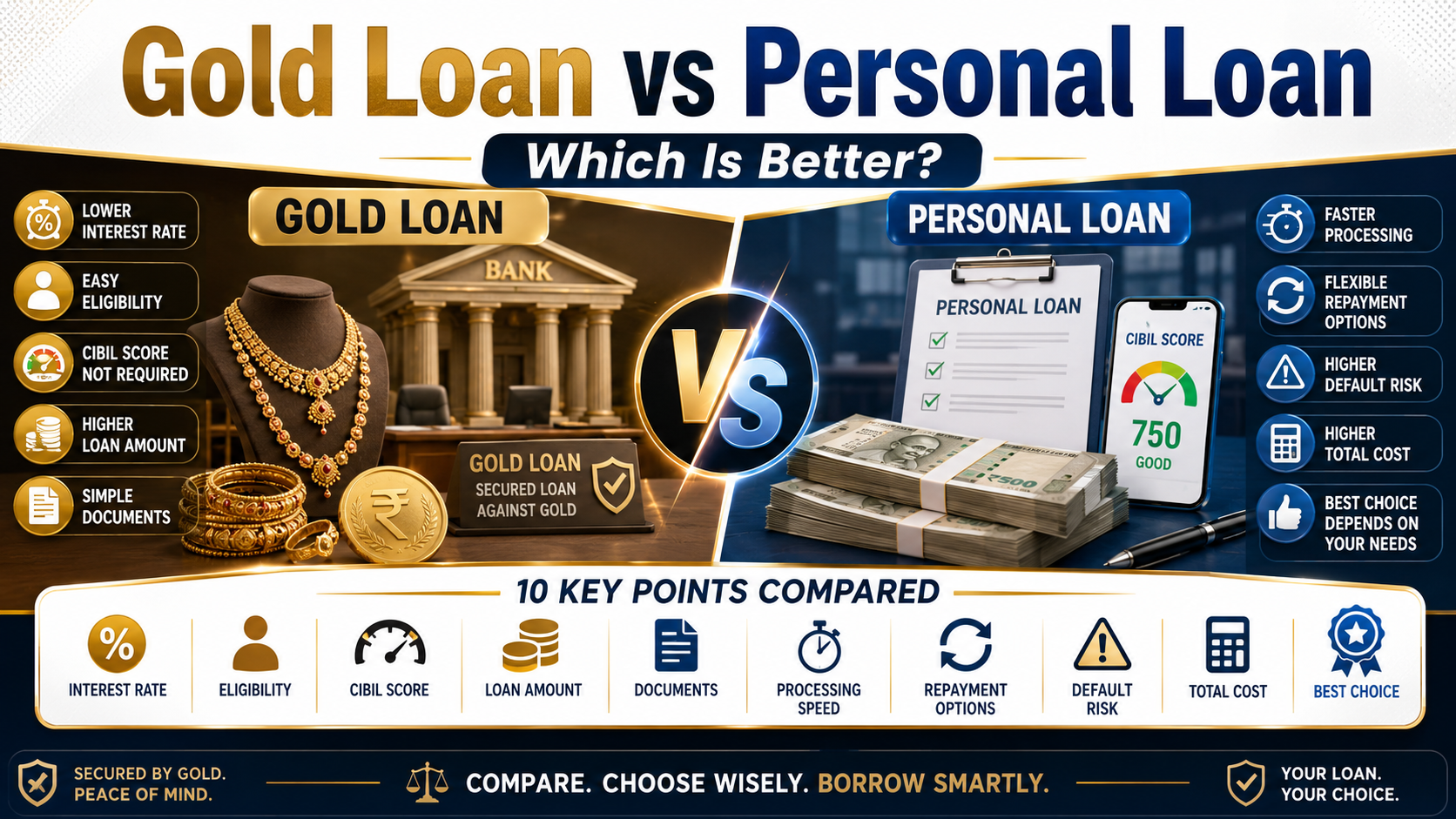
You can also read our Gold Loan Process guide, Gold Loan Interest Rate Calculation guide, Gold Loan vs Personal Loan guide and Gold Loan Gold Requirement guide.
The right Gold Loan Repayment Options should remain manageable from the first payment to final closure. Most importantly, do not choose a repayment plan only because the first few months look easy. Think about the entire loan period and how you will arrange every payment, especially the final payment under a bullet structure.
Disclaimer
This article is for general informational and educational purposes only and should not be treated as financial advice. Interest rates, repayment options, tenures, prepayment conditions, processing charges and lender policies can change. Always verify the latest terms directly with the relevant regulated bank, NBFC or lender before applying for a gold loan.


Pingback: Gold Loan Na Chukane Par Kya Hota Hai? 5 Serious Risks
Pingback: Gold Loan Eligibility: 8 Important Criteria and Documents