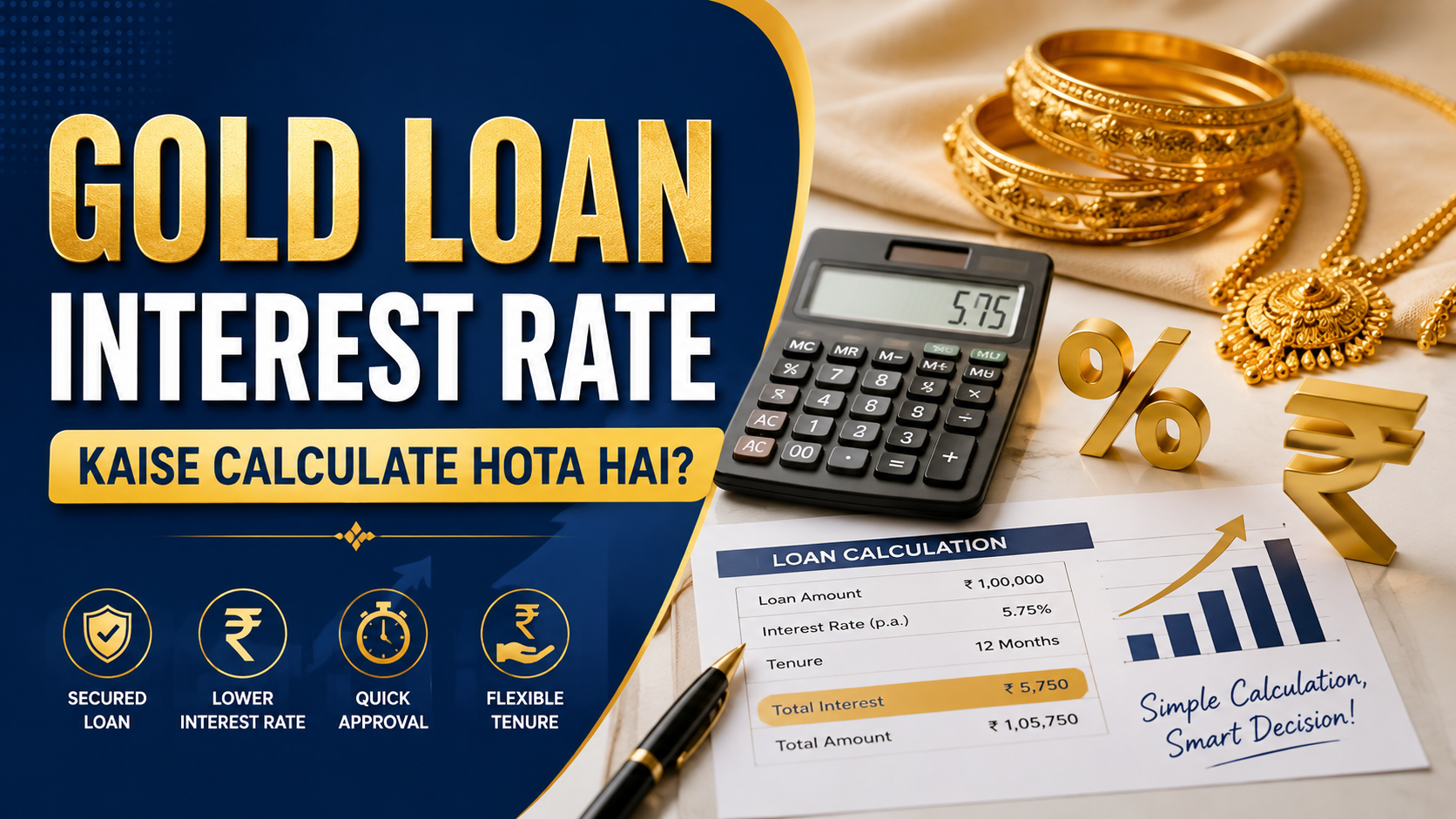

Gold Loan Interest Rate Calculation: 10 Easy Cost Factors
Gold Loan Interest Rate Calculation helps you understand how much a gold loan may actually cost before you pledge your jewellery. Looking only at the advertised annual rate is not enough because the final interest can also depend on the loan amount, tenure, repayment structure and additional charges.
Different banks and NBFCs may offer EMI, bullet-repayment and overdraft-based gold loans. Even if two lenders advertise similar annual rates, the final amount you pay can be different. This guide from Loan Enquiry For You explains the calculation in simple language with practical examples.

Table of Contents
1. Gold Loan Interest Rate Kya Hota Hai?
A gold loan interest rate is the price you pay for borrowing money against pledged gold. It is normally expressed as an annual percentage rate, such as 9% or 10% per annum.
However, Gold Loan Interest Rate Calculation is not always as simple as multiplying the original loan amount by the annual rate. The actual interest payable may depend on the outstanding balance, the period for which the loan remains active and whether the product uses EMI, bullet repayment or an overdraft facility.
Because a gold loan is secured by jewellery, its pricing can differ from an unsecured personal loan. Even then, every bank or NBFC does not offer the same rate. A lender can have several gold-loan products with different interest structures.
For example, SBI publishes different effective rates for its EMI, bullet-repayment and overdraft gold-loan variants. This is why borrowers should check the exact product instead of assuming that one advertised gold-loan rate applies to every repayment option.
The annual rate shown by the lender tells you only part of the story. Your total cost also depends on how long the money remains outstanding and how repayments reduce or do not reduce the principal.
Before accepting a loan, check the sanction letter or Key Fact Statement. It should help you understand the applicable rate, repayment method and important charges. This is the best starting point for an accurate Gold Loan Interest Rate Calculation.
2. Gold Loan Interest Rate Decide Kaise Hota Hai?
A gold loan interest rate is not always a random figure. Depending on the lender and product, the rate may be linked to an internal or external benchmark plus a spread or margin.
For example, SBI publishes gold-loan pricing structures that show a benchmark and separate spread for different repayment variants. The benchmark plus the applicable spread results in the effective rate for that particular scheme. You can review current lender-specific information on the official SBI Personal Gold Loan page.
Other factors may also influence the rate offered under a product. These can include the repayment structure, loan tenure, lender policy and prevailing market conditions.
The value of your gold mainly affects how much you may be eligible to borrow. It should not be confused with the interest rate itself. Higher purity or greater eligible gold weight may increase your possible loan amount, but the lender still applies the rate of the product you choose.
ICICI Bank also explains that gold-loan pricing and product terms can vary. Its official gold-loan resources are useful when comparing how different lenders structure their products.
For a better Gold Loan Interest Rate Calculation, ask the lender four questions: Which product is this rate for? Is it benchmark-linked or fixed under the product terms? Which repayment method applies? Can the effective rate change during the loan?
3. Gold Loan Interest Calculate Karne Ka Basic Formula
The easiest way to understand Gold Loan Interest Rate Calculation is to begin with a simple-interest illustration.
Interest = Principal × Annual Interest Rate × Time
Principal means the loan amount. The annual interest rate is the percentage charged by the lender, and time represents how long you use the money.
Suppose you borrow ₹1,00,000 at 10% per annum for six months. For a basic simple-interest illustration:
₹1,00,000 × 10% × 6/12 = approximately ₹5,000 interest.
This example is useful for understanding the relationship between principal, rate and tenure. It does not mean every gold-loan product will calculate interest in exactly this way.
An EMI-based loan normally reduces the outstanding principal as monthly payments are made. A bullet loan can keep more or all of the principal outstanding until maturity. An overdraft product can calculate interest according to utilisation and its own account terms.
RBI rules and lender agreements may also specify how interest is applied under particular repayment structures. For the latest regulatory information, use the official Reserve Bank of India website.
Therefore, use the simple formula as a learning tool and rely on the lender’s repayment schedule for the final calculation.
4. Loan Amount Interest Cost Ko Kaise Affect Karta Hai?
The amount you borrow directly affects the amount of interest you may pay. If two borrowers receive the same annual rate for the same period, the borrower with the larger outstanding principal will normally have a higher interest cost.
For example, interest on ₹2 lakh will generally be higher than interest on ₹1 lakh when the rate, tenure and calculation method are otherwise the same.
This is an important part of Gold Loan Interest Rate Calculation because borrowers sometimes confuse the maximum loan they are eligible for with the amount they actually need.
Your eligible amount depends on factors such as gold purity, net eligible weight, gold valuation and applicable Loan-to-Value limits. A lender may tell you that your jewellery supports a larger loan, but that does not mean you must borrow the maximum available amount.
ICICI Bank’s official Gold Loan Calculator uses inputs such as gold weight, purity and other product variables to provide an indicative estimate. Final eligibility still depends on actual verification and lender policy.
If you need ₹1 lakh but qualify for ₹2 lakh, borrowing the extra amount unnecessarily can increase interest and repayment pressure.
A practical approach is to calculate your actual financial requirement first and then borrow only what you genuinely need.
5. Gold Loan Tenure Se Interest Kaise Badhta Hai?
Loan tenure means the period for which your loan remains outstanding. In most comparable situations, a longer outstanding period can increase the total interest cost.
Imagine two borrowers take the same ₹1 lakh gold loan at the same annual rate. One repays the loan after three months while the other keeps it outstanding for twelve months. If all other conditions are the same, the second borrower will normally pay more total interest because the money was borrowed for longer.
Tenure is therefore a key input in Gold Loan Interest Rate Calculation. You should not look only at the monthly payment or maturity amount. Always consider the complete repayment period.
Different banks and NBFCs offer different tenure options, and repayment structures can also change the way interest behaves over that period.
- Compare the monthly or maturity payment.
- Check total estimated interest.
- Consider your expected income.
- Check prepayment conditions.
- Choose a tenure you can realistically manage.
A longer tenure may appear comfortable because you receive more time to repay, but it can also keep the balance outstanding for longer.
Do not automatically choose the longest available option. A better approach is to choose the shortest tenure that fits your budget without creating repayment stress.
6. EMI Gold Loan Me Interest Kaise Calculate Hota Hai?
In an EMI-based gold loan, the borrower makes regular monthly payments according to a repayment schedule. EMI stands for Equated Monthly Instalment.
A typical EMI contains both principal and interest. As the outstanding principal reduces through repayments, the interest component can also change over the life of the loan.
This means Gold Loan Interest Rate Calculation for an EMI product should not be compared directly with a bullet loan using only the headline annual percentage.
In many amortising loans, the earlier instalments contain a higher interest component because the outstanding balance is larger. As the principal is gradually repaid, a larger part of later instalments can go toward principal.
The three main inputs are:
- Loan Amount: The principal borrowed.
- Interest Rate: The annual rate applicable to the product.
- Tenure: Number of months over which the loan is repaid.
An online EMI calculator can provide an estimate, but the lender’s final repayment schedule is more important. Ask for the amortisation or repayment schedule before accepting the loan.
That schedule lets you see the monthly amount, total estimated interest and the way the outstanding balance changes over time. It also helps you judge whether the EMI fits your monthly budget.
7. Bullet Repayment Gold Loan Me Interest Kaise Lagta Hai?
Bullet repayment works differently from a normal EMI-based loan. Instead of gradually reducing the principal through standard monthly principal instalments, the principal is generally payable according to the maturity conditions of the product.
Depending on the scheme, the borrower may need to repay the principal and accumulated interest at or before maturity.
This repayment structure changes the Gold Loan Interest Rate Calculation because the principal may remain outstanding for much of the loan period rather than reducing month by month as it would under an amortising EMI structure.
A bullet loan can appear convenient for someone who expects a future lump-sum inflow, but the maturity payment can become significant.
Before choosing bullet repayment, ask:
- When does interest become payable?
- How frequently is interest applied to the account?
- What total amount is expected at maturity?
- Can the loan be prepaid?
- Are there renewal conditions?
- What happens if maturity is missed?
Do not compare a bullet loan with an EMI loan only by looking at the annual rate. Compare the total amount you are expected to pay under each repayment structure.
A bullet loan is practical only when you have a realistic plan to arrange the maturity amount on time.
8. Gold Loan Overdraft Me Interest Kaise Calculate Hota Hai?
A gold-loan overdraft can work differently from both EMI and bullet-repayment products. Instead of receiving the entire approved amount as a normal term loan, the lender can provide a credit limit against your pledged gold.
You may then use money from that available limit according to the product’s conditions.
For Gold Loan Interest Rate Calculation in an overdraft facility, an important question is whether interest is charged on the amount actually utilised or according to another outstanding-balance rule defined by the lender.
Suppose a lender approves a ₹3 lakh limit but you use only ₹1 lakh. Depending on the exact product terms, the interest-bearing amount may be linked primarily to the utilised balance rather than the unused part of the limit.
This structure can be useful for someone who needs flexible access to funds instead of the entire loan amount on day one.
Before accepting an overdraft, ask whether interest is calculated daily, monthly or according to another method. Also check account-maintenance charges, interest-servicing requirements and any minimum-use conditions.
Flexible access can help reduce unnecessary borrowing when used carefully, but an available credit limit can also encourage you to use more money than you originally needed.
Use only the amount required and repay utilised funds as early as practical under the product terms.
9. Processing Fee Aur Other Charges Interest Rate Se Alag Hain
The lowest advertised interest rate does not automatically mean the cheapest gold loan.
Interest is only one part of the total cost. A complete Gold Loan Interest Rate Calculation should also consider compulsory charges associated with the product.
- Processing fee
- Gold appraisal or valuation charges
- Applicable taxes such as GST on eligible fees
- Documentation or statutory charges where applicable
- Penal or overdue charges
- Other fees stated in the agreement
Two loans with similar rates can therefore have different overall costs.
For example, Lender A may offer a slightly lower annual rate but charge a comparatively high processing fee. Lender B may have a slightly higher annual rate but much lower upfront charges. Depending on the loan amount and tenure, the second offer could still cost less.
Instead of asking only, “Interest rate kitna hai?”, also ask, “Total kitna paisa dena padega?”
Review the Key Fact Statement, sanction letter and fee schedule before pledging your jewellery. Separate compulsory charges from optional services and ask the lender to explain any amount you do not understand.
Even a small difference in fees can matter on a short-term loan, especially when the principal amount is not very large.
10. Gold Loan Ka Total Cost Kaise Compare Karein?
The best way to compare gold loans is to compare the total borrowing cost for the same approximate loan amount and tenure.
A proper Gold Loan Interest Rate Calculation should consider more than the annual percentage printed in an advertisement.
- Annual interest rate
- Loan amount
- Repayment structure
- Tenure
- Total estimated interest
- Processing fee
- Gold appraisal charges
- Applicable taxes
- Prepayment conditions
- Late-payment or penal charges
- Amount payable at maturity
Do not compare an EMI loan, bullet loan and overdraft as if they are identical. An EMI loan generally reduces principal over time, a bullet loan may keep more principal outstanding until maturity, and an overdraft may use a different outstanding-balance method.
Use online calculators for estimates, but verify the result with the lender’s final repayment schedule and Key Fact Statement.
The cheapest loan is not necessarily the product with the smallest advertised percentage. It is the loan that gives you a reasonable total cost and a repayment structure you can comfortably manage.
Gold Loan Interest Rate Calculation: Quick Checklist
- Write down the exact amount you need.
- Check the annual interest rate.
- Confirm the repayment structure.
- Compare the same tenure across lenders.
- Calculate estimated total interest.
- Add processing and appraisal fees.
- Check applicable taxes and penalties.
- Read the Key Fact Statement.
- Review the repayment schedule.
- Borrow only what you can comfortably repay.
Frequently Asked Questions
What Is the Basic Gold Loan Interest Formula?
For a simple illustration, interest can be understood as Principal × Annual Rate × Time. The actual lender calculation may differ depending on whether the loan uses EMI, bullet repayment, overdraft or another approved repayment structure.
Does a Longer Gold Loan Tenure Increase Interest?
When other conditions are comparable, keeping a loan outstanding for a longer period generally increases total interest. The exact result depends on the repayment structure and how principal reduces during the tenure.
Is Gold Loan Interest Calculated on the Full Gold Value?
No. Interest applies to the loan or outstanding amount according to the product terms. The value of the pledged gold is mainly used to determine how much loan may be available under applicable valuation and LTV rules.
Which Is Cheaper: EMI or Bullet Repayment?
There is no universal answer. The result depends on the rate, tenure, principal outstanding, repayment timing and fees. Compare the total repayment amount under both structures instead of comparing only the annual rate.
Should I Use an Online Gold Loan Calculator?
An online calculator is useful for an indicative estimate, but the final lender-approved amount, interest and repayment schedule should be treated as authoritative.
Conclusion: Understand Gold Loan Interest Rate Calculation Before Borrowing
Gold Loan Interest Rate Calculation can help you avoid choosing a loan based only on an attractive advertisement. The actual cost depends on the principal, annual rate, tenure, repayment structure and additional charges.
An EMI loan, bullet-repayment loan and overdraft facility can produce different total borrowing costs even when their advertised rates appear similar. Compare the complete repayment obligation and verify current lender information before making a decision.
You can also read our Gold Loan Kaise Le guide and Gold Loan Process guide for more information about eligibility, valuation, documents and application steps.
Always confirm the latest rate, processing fee and repayment conditions with the relevant regulated bank or NBFC before pledging your jewellery.
Disclaimer
This article is for general informational and educational purposes only. It should not be treated as financial advice or a guarantee of any particular loan rate. Interest rates, charges, repayment structures and lender policies can change. Always verify the latest terms directly with the relevant regulated bank, NBFC or lender before applying for a gold loan.

Pingback: Gold Loan Ke Liye Kitna Gold Chahiye? 10 Important Facts
Pingback: Gold Loan vs Personal Loan: 10 Key Differences
Pingback: Gold Loan Repayment Options: 10 Smart Methods Explained